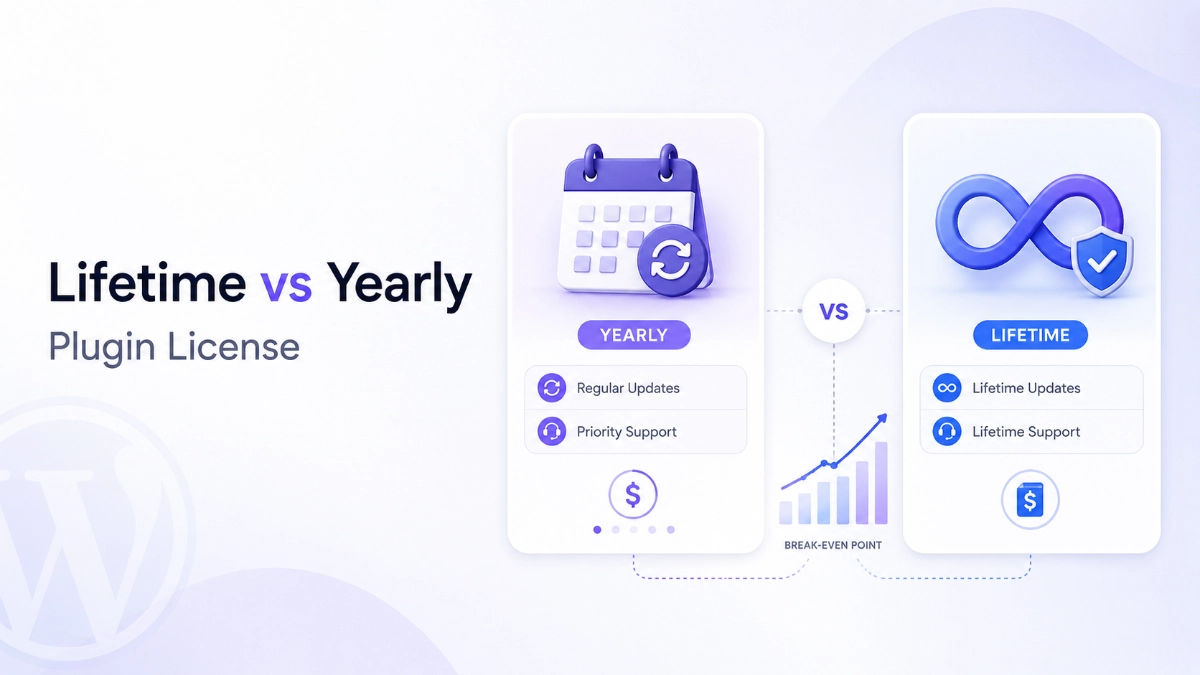

For most buyers, the lifetime vs yearly plugin license choice comes down to three things: expected usage time, break-even cost, and how much flexibility you need. You’ve found a WordPress plugin you like, and now you’re staring at two prices: pay every year, or pay once and be done with it. The lifetime vs yearly plugin license decision feels bigger than it should, mostly because upfront price alone doesn’t tell the whole story. The cheaper option today isn’t always cheaper three years from now, and the bigger one-time charge isn’t automatically the smarter buy either.
The right answer depends on how long you’ll actually use the plugin, how many sites you run, and what each license really includes past the checkout page. This guide walks through a practical decision framework instead of a sales pitch: how to calculate your break-even point and which license terms are worth confirming before you pay.
Should you buy a lifetime or yearly WordPress plugin license? Lifetime licenses generally work out cheaper for long-term, repeated use, since one payment can replace years of renewals. Yearly licenses generally suit short-term projects, testing a plugin, or a lower upfront commitment. The right choice comes down to your break-even period and the specific license terms attached to the plugin you’re buying.
Last reviewed: July 2026. Licensing terms, pricing, and policies change over time — always confirm current details on the specific plugin’s pricing and license pages before purchasing.
Key Takeaways
- Lifetime usually pays off for buyers who expect to use a plugin for several years across a small, stable number of sites.
- Yearly usually fits short projects, trial periods, or anyone who’d rather pay less today than more upfront.
- Upfront price alone is misleading — divide the lifetime price by the yearly price to find your break-even point in years before deciding.
- An active license drives updates and support, not necessarily whether the plugin file keeps running — confirm the exact behavior for your specific plugin.
- “Lifetime” describes the license terms in effect at purchase, not a guarantee that a company or product will exist forever.
- Refund terms often differ by license type — standard purchases may carry a refund window that lifetime purchases don’t, so check before you buy.
- Confirm site limits, upgrade rules, and expiration behavior on the plugin’s own pricing and license pages, since these vary by product.
Table of Contents
What Does a Yearly Plugin License Mean?
A yearly plugin license works like a subscription: you pay upfront for a year of access, and that payment typically covers automatic updates and support for the term — ThemeAtelier’s pricing pages list a defined support and update period alongside each yearly tier.
Renewal and expiration aren’t quite the same thing. Canceling future billing stops the next charge; letting a license expire just means the covered term ended without a new payment. Neither is the same as deleting the plugin yourself.
Site limits typically apply per tier — single-site, five-site, or unlimited-site — with yearly and lifetime priced separately at each level. ThemeAtelier’s documentation ties an active license to continued updates and support, without spelling out whether the plugin file stops functioning once it expires — [CONFIRM CURRENT POLICY] for the specific product. What’s consistent: without an active license, you lose access to new downloads and can’t open a support ticket.
What Does a Lifetime Plugin License Mean?
A lifetime license is a one-time payment instead of a recurring one, typically listed with ongoing support and automatic updates at the same site-based tiers used for yearly plans.
Here’s the clarification that matters most: lifetime doesn’t automatically mean a permanent guarantee that a plugin, or the company behind it, will exist forever. ThemeAtelier’s own guidance on lifetime software deals makes this point directly — a lifetime license doesn’t always mean lifetime updates or support, across the software industry generally. In practice, “lifetime” refers to the license terms attached to your purchase: ongoing access for as long as the product stays actively maintained, not a legal promise of indefinite development.
Lifetime plans don’t automatically include future, separately-sold products or major add-ons unless a listing says so [CONFIRM CURRENT POLICY]. Refund treatment also tends to differ: standard purchases commonly carry a limited refund window, while lifetime purchases are often excluded due to processing costs and misuse risk. Confirm the REFUND POLICY URL before paying the larger upfront amount.
Lifetime vs Yearly Comparison Table
A lifetime vs yearly plugin license comparison becomes much easier when you look at cost, updates, support, flexibility, and long-term risk side by side.
| Decision factor | Yearly license | Lifetime license |
|---|---|---|
| Upfront cost | Lower initial commitment | Higher upfront commitment |
| Recurring payments | Yes, typically annual | No recurring license payment |
| Long-term cost | Can exceed lifetime price over several years | Often lower after the break-even point |
| Updates | Usually included while active | Depends on official terms |
| Technical support | Usually included while active | Depends on official terms |
| New feature access | Included during active term | Confirm current policy |
| Site limits | Set per tier at purchase | Set per tier at purchase |
| Budget predictability | Recurring line item each year | One payment, easier to forecast |
| Flexibility to stop paying | High — simply don’t renew | Not applicable, no renewal exists |
| Risk if you stop using the plugin | Lower, since payments can stop anytime | Higher, since the payment is already made |
| Risk if the plugin is discontinued | Lower financial exposure going forward | Depends on how long you’ve already used it |
| Upgrade options | Often upgradeable to lifetime, confirm terms | Typically upgrades to a higher site tier only |
| Transfer or resale | Not normally transferable | Not normally transferable |
| Best for short-term projects | Usually the better fit | Rarely justified |
| Best for long-term use | Can work, but may cost more over time | Usually the better fit |
| Best for agencies | Depends on client turnover | Often better across repeat projects |
| Best for first-time buyers | Lower-risk way to test a plugin | Confirm current policy before committing |
How Do You Calculate the Break-Even Point?
The simplest way to compare a lifetime vs yearly plugin license is a break-even calculation: Break-even period = Lifetime price ÷ Annual license price. The result tells you how many years of renewals the lifetime price would need to cover before it becomes the cheaper option.
That formula is a starting point, not the whole picture. Adjust it if renewal pricing differs from the first year’s price, if renewal discounts apply, if you’ll need more sites later, if taxes or VAT change your checkout total, or if a lifetime discount is only temporary. A promotional first-year yearly price can also shift the math in year two.
Here’s a hypothetical example using generic, illustrative numbers — not ThemeAtelier’s actual prices for any product. Say a yearly license costs $59 per year and a lifetime license costs $179 one time. Dividing $179 by $59 gives a break-even point of roughly three years. If you expect to use the plugin longer than that, lifetime likely saves money. If you expect to stop sooner, yearly is the safer bet. Replace these numbers with the current prices of the plugin you’re actually comparing.
When Is a Lifetime License Usually the Better Choice?
In a lifetime vs yearly plugin license decision, lifetime tends to make sense when you expect to use the plugin for several years, especially if it becomes part of a workflow your business depends on.
It also suits buyers who want predictable costs and dislike tracking renewals, particularly when the break-even period is short relative to expected use. That said, lifetime value depends entirely on continued use — a one-time payment isn’t a saving if you abandon the plugin months later. The upfront cost should be affordable without straining your budget, since there’s usually no refund safety net on lifetime purchases.
When Is a Yearly License Usually the Better Choice?
Yearly licenses fit situations where commitment is uncertain: testing a new plugin, running a temporary client project, or simply not knowing yet whether the tool fits your workflow. A lower upfront cost keeps cash available for other priorities.
Choosing yearly isn’t a lesser or less-committed decision — it’s often the rational one when the break-even period is long, a redesign or platform switch is likely soon, or the plugin is useful now but not yet business-critical. It leaves room to reassess annually rather than locking in a larger payment early.
What Questions Should You Ask Before Choosing?
Before making a lifetime vs yearly plugin license decision, run through this short list of questions. The answers matter more than the sticker price. The answers matter more than the sticker price.
- How many years am I realistically likely to use this plugin?
- How many websites need activation, and do staging or development sites count toward that limit?
- Does the plugin keep working after a yearly license expires, and which updates and support are included?
- Can I upgrade from yearly to lifetime later, and is any previous payment credited toward that upgrade?
- Can I increase my site limit later, and is the license transferable or usable on client websites?
- What happens if the plugin is discontinued, and what’s the current refund window?
- Does the displayed price include taxes or VAT, and is checkout in my preferred currency?
- Does the license cover every add-on, or only the core plugin?
What Happens If You Stop Renewing a Yearly License?
This is one of the biggest buyer hesitations, so it’s worth separating three things. First, the plugin file usually stays installed regardless of license status — nothing deletes it automatically. Second, whether it keeps functioning without an active license depends on the specific plugin’s terms; ThemeAtelier’s documentation confirms an active license keeps updates and support flowing, without stating that the plugin stops running entirely [CONFIRM CURRENT POLICY]. Third, and most consistently: you’ll lose access to new downloads and new support requests once the license lapses. If a plugin relies on a connected cloud service or API, that service may also require an active subscription — check this for any plugin with a hosted component.
What Happens If the Plugin Is Discontinued?
This is a general software-purchasing risk, not a comment on any specific ThemeAtelier product’s future. Neither license type guarantees indefinite development — no company can promise that with certainty.
Financial exposure differs by timing rather than license type alone. A lifetime buyer who’s used a plugin for years before it’s discontinued has already gotten substantial value from the one payment; a recent buyer carries more exposure. A yearly buyer’s downside is simpler: they stop renewing and stop paying. An installed plugin may keep functioning for a while either way, but compatibility, security, and future WordPress updates can eventually create problems without ongoing maintenance. Any refund or migration help depends on the terms in place at the time, plus applicable consumer-protection law.
Are Lifetime Plugin Licenses Sustainable for Developers?
Software companies offer lifetime pricing for practical reasons: it brings in upfront capital, lowers hesitation at checkout, helps a newer product build an install base, and can work well as a limited-time or portfolio-wide strategy alongside standard subscription pricing.
There are real limits, too. Ongoing development, support, and third-party infrastructure costs don’t stop just because the payment was one-time. That’s generally why lifetime deals come with site-activation limits and defined support scope — not because one-time pricing is inherently unsustainable, but because it has to be balanced against continuing costs.
Can You Upgrade From Yearly to Lifetime Later?
Often, yes. ThemeAtelier’s license-upgrade system works on a pay-the-difference model for at least one product: you’re only charged the gap between what you already paid and the new license’s price, rather than paying from scratch. Upgrades are typically handled from your account dashboard, under license management.
What isn’t confirmed across every plugin is whether that same logic applies specifically to a yearly-to-lifetime move, versus upgrades between site tiers [INSERT PRODUCT-SPECIFIC UPGRADE POLICY]. Before assuming credit toward an upgrade, check the UPGRADE POLICY URL for the specific plugin, since promotional lifetime offers sometimes carry separate conditions.
License Ownership, Resale, and Transfers
Buying a plugin license generally grants permission to use the software under defined terms — it doesn’t transfer ownership of the software or its code. That distinction matters when you’re thinking about a lifetime license as an “asset” rather than ongoing permission to use a tool.
License-key sharing, moving a license between your own sites, client-site use, or transferring it if you sell a business are all governed by the specific product’s [LICENSE TERMS URL]. Don’t assume a lifetime license can be resold like a domain name — confirm resale and transfer rules first [CONFIRM CURRENT POLICY].
Decision Guide by Buyer Type
- First-time buyer: Usually yearly. Lower risk while you confirm the plugin fits your site.
- Single-site business owner: Depends on break-even and how long the site will run in its current form.
- Blogger or personal-site owner: Usually yearly, unless the plugin is central to the site’s long-term identity.
- WooCommerce store: Usually lifetime if the plugin supports core store operations you’re not planning to replace.
- Freelancer: Depends on how many client sites qualify under one license and how often you reuse the tool.
- WordPress agency: Usually lifetime when site limits and terms support repeat use across projects.
- Temporary project owner: Usually yearly. Paying for years of use you won’t need rarely makes sense.
- Long-term product user: Usually lifetime once the break-even period is comfortably shorter than expected use.
- Buyer with limited upfront budget: Usually yearly, to preserve cash flow even if the long-term cost is slightly higher.
- Buyer managing several qualifying sites: Depends on the site-tier pricing gap and whether an unlimited-site lifetime tier exists.
Final Recommendation
Start with yearly when uncertainty is high, the project is temporary, or cash flow matters more than long-term savings. Consider lifetime once long-term use looks likely and the break-even period is reasonable for how you actually plan to use the site. Either way, review site limits, updates, support, upgrade rules, and discontinuation terms before you pay — not just the price on the checkout page.
Choose based on how you expect to use the plugin, not fear of missing a one-time deal or discomfort with an annual bill. Both models are legitimate; the right one just depends on your situation.
Still deciding which license fits your needs? Compare the current yearly and lifetime options for [PLUGIN NAME] on the [PLUGIN NAME] pricing page. You can also review the license terms and refund policy before purchasing.
FAQ – Lifetime vs Yearly plugin license
Is a lifetime WordPress plugin license worth it?
It’s worth it if you expect to use the plugin for at least as long as the break-even period — lifetime price divided by yearly price — and you’re comfortable with the larger upfront cost and limited refund eligibility. For short-term or uncertain use, yearly usually makes more sense.
Do lifetime licenses include future updates?
Usually, for as long as the product stays actively maintained, but “lifetime” isn’t a guarantee of permanent development. Whether major future versions or add-ons are included can vary by product, so confirm the current license terms before assuming full coverage.
Does a lifetime license include lifetime support?
Many lifetime plans advertise ongoing support, but scope and duration depend on the specific product’s terms. Support and updates are separate commitments, so check both rather than assuming one implies the other.
What happens when a yearly plugin license expires?
You lose access to new downloads, updates, and new support requests for that product. Whether the installed plugin keeps running without an active license depends on the specific terms, so confirm this before letting a license lapse on a site you depend on.
Will the plugin stop working if I cancel renewal?
Not automatically. Canceling renewal simply stops the next charge; the plugin file typically remains installed. Whether it keeps operating without an active license is a separate, product-specific question worth confirming directly.
What happens to a lifetime license if the plugin is discontinued?
No license type guarantees indefinite maintenance. A long-time lifetime user has typically already gotten strong value from the one-time payment; a recent buyer carries more exposure. Any refund or migration path depends on the terms in effect and applicable consumer law.
Can I switch from a yearly license to lifetime later?
Often, through a pay-the-difference upgrade rather than paying full price again. Whether prior payments are credited, and whether the option is available for every product, depends on that plugin’s current upgrade policy — confirm it before assuming credit applies.
Can a lifetime plugin license be transferred or resold?
Not typically. A license grants permission to use software under defined terms rather than ownership of an asset you can resell. Moving a license between your own sites, or to a client, generally depends on the product’s license terms.
How do I calculate the break-even point?
Divide the lifetime price by the annual price. If a plugin costs $59 per year and $179 for lifetime, the break-even point is roughly three years. Adjust for renewal-price changes, discounts, or promotional first-year pricing, since those can shift the real number.